
The Kaizen Investor…
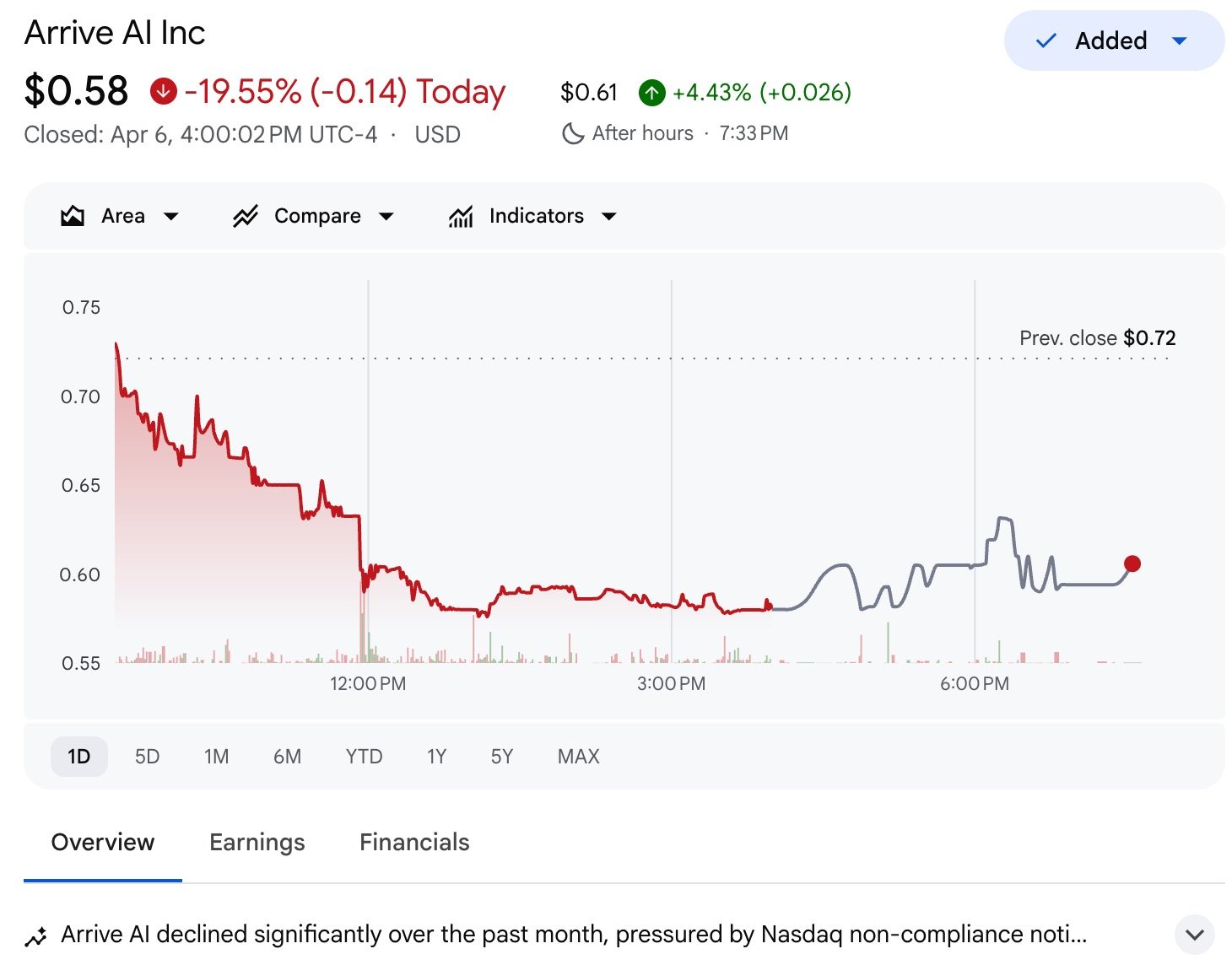
Arrive AI Stock Price on Monday April 6 2026
The Kaizen Investor: Why a $100 Stake in Arrive AI Taught Me More About Execution Than a Spreadsheet Ever Could
By Tony Maden (In collaboration with Google Finance AI)
The "Small Nobody" Disclaimer
I am not a Wall Street analyst. I am a retail investor who plays in the market with small amounts—typically $100 at a time—to learn the "language of the engine." My background is in Operations Management and Continuous Improvement (Kaizen). I don't look at stock charts to see where the price is going; I look at a company’s operations to see if they actually know how to build a profitable business.
The Patent Paradox: Blueprints vs. Buildings
Arrive AI (NASDAQ:ARAI) often touts its "first-to-market" advantage, having filed its foundational smart mailbox patent in 2014, just four days before Amazon (NASDAQ:AMZN). Today, they hold 10 U.S. patents.
My Operational Take: A patent is a blueprint, but a blueprint isn't a building. In my world of Continuous Improvement, you don't have a product until you have a repeatable, scalable process. Currently, Arrive AI is stuck in a "Pilot Bottleneck." They have one medical delivery pilot at a hospital in Indiana. To a Kaizen specialist, one case study is an anecdote; ten simultaneous pilots in different sectors is a business. Without that diversity, they aren't testing the "Process," they are just managing a single relationship.
The HR Metric: What a Job Interview Taught Me About the Stock
I recently applied for a Quality Technician position with Arrive AI. I went through a video interview and put in the effort to show how my expertise could make their "geeky stuff" talk to itself profitably. That was over a month ago. Silence.
In a healthy startup, a month of silence after a video interview for a critical quality role is a Lead Indicator of internal "Firefighting Mode." It suggests:
Broken Standard Operating Procedures (SOPs): If they can't manage a hiring funnel, can they manage a nationwide infrastructure?
Budget Instability: Silence often follows a sudden hiring freeze when the "Cash Burn" gets too high.
Translating "Guts" to "Greeks" (The AI Analysis)
I shared my gut feelings with Google’s AI to see if the math backed up my operational intuition. The numbers for April 2026 are stark:
The Revenue Gap: The company generated roughly $98,200 in revenue over the last year but lost over $10 million.
The Salary Mismatch: The $65,000 salary for the technician role I applied for represents nearly 70% of their total annual revenue. That is an "upside down" operation.
The Nasdaq Clock: On March 31, 2026, the company was flagged for non-compliance. Their market value has dropped below $50 million, and they have until September 28, 2026, to fix it or face delisting.
Lessons Learned
My $100 investment in Arrive AI is currently down, but the education was worth every penny.
Patents ≠ Profits: Intellectual property is a defense, not an offense. Execution is the only way to score.
Avoid the "Launch Party" Trap: High-profile events and "geeky" tech are great, but if the Cash Burn is 100x the Revenue, the Kaizen isn't working.
Operational Due Diligence: Your professional skills are your best investment tools. If a company fails the "Operations Test," it will eventually fail the "Market Test."

On Conversational AI
Most conversations about AI focus on speed, output, or automation.
Those things matter — but they’re not where my interest begins.
What I’m increasingly drawn to is conversational AI:
AI used not as a command-driven tool, but as a space for thinking, reflection, and dialogue.
In my own work, I’ve found that the most meaningful use of AI doesn’t come from asking it to produce something quickly, but from engaging it as a thinking companion — one that helps surface assumptions, clarify language, and slow ideas down enough to be examined honestly.
This kind of interaction isn’t transactional.
It’s relational.
Not in the sense that AI replaces human presence — it shouldn’t — but in the sense that a well-held conversation can help a person hear themselves more clearly.
Used this way, conversational AI becomes less about answers and more about attention:
Attention to language
Attention to intention
Attention to what’s actually being asked beneath the question
That matters deeply in work involving people — whether that’s storytelling, training, faith communities, or organizational communication.
I’m cautious here on purpose.
Technology should serve human clarity, not displace it.
It should support reflection, not rush past it.
And it should remain accountable to human judgment, ethics, and care.
In future writing, I plan to explore this distinction more fully — particularly the difference between transactional AI useand conversational AI use, and why that difference shapes outcomes more than most people realize.
For now, this is simply an opening thought:
AI can be used to move faster —
or it can be used to listen better.
The choice matters.